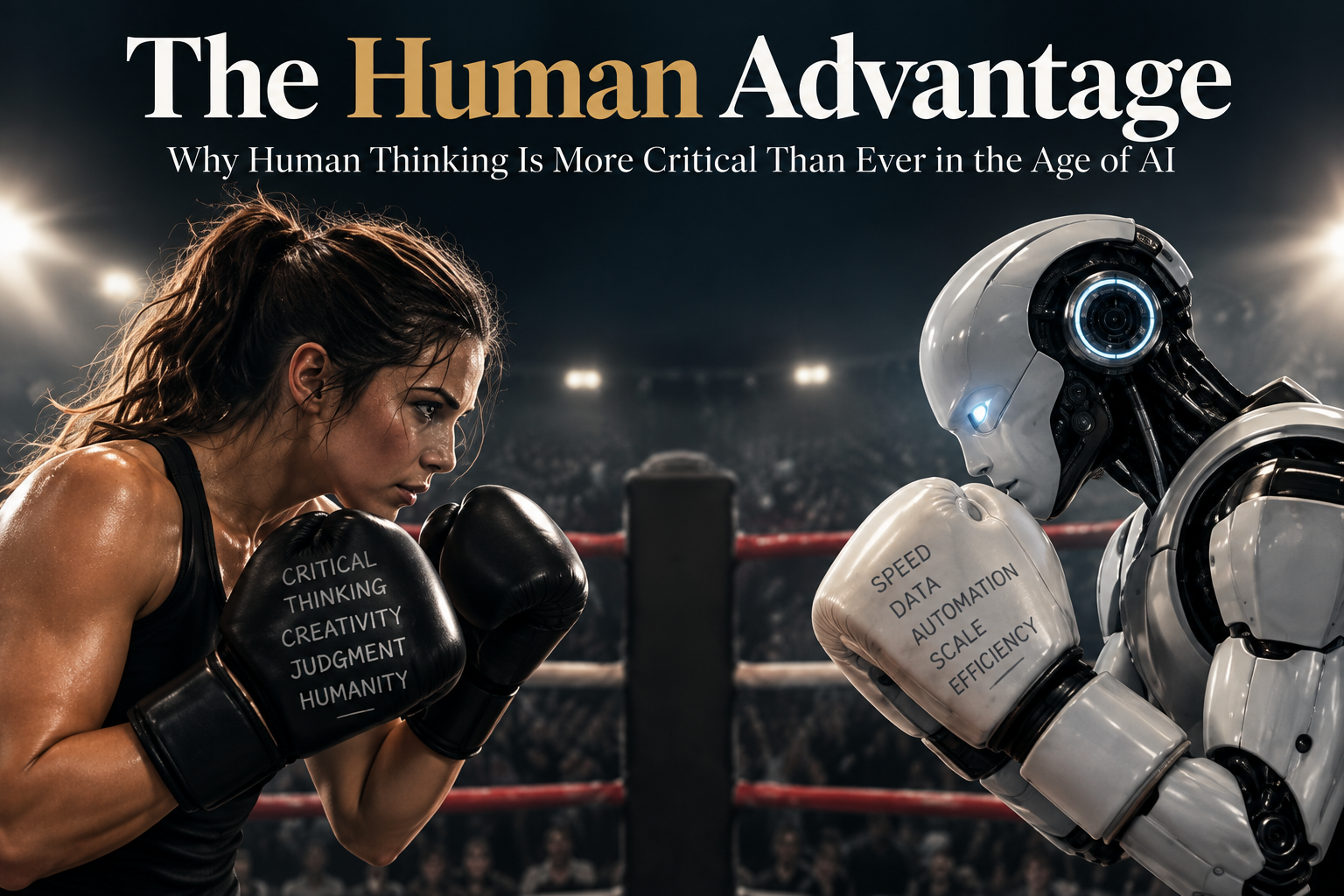
The Human Advantage
Why Human Thinking Is More Critical Than Ever in the Age of AI
By Jocelyn Little
September 14, 2026
AI is not going to take our jobs. We are giving our jobs away to AI.
Before you get into the debate, let me explain. The more people use AI, the more risk there is for intellectual laziness. As AI makes my job easier, faster, more proficient, or just does it for me, the less I have to think and do, right? And if AI does my job for me, why wouldn’t a company pay $50 a month for an LLM instead of my monthly salary in the thousands?
AI isn’t replacing human value. But sometimes humans voluntarily remove their own value by surrendering their judgment to the technology. It’s not as simple as “replace this employee with an LLM.” But let’s take a deeper look into how intellectual laziness can undercut our value and undersell our talents.
While people can be — and often begin to build habits of becoming — intellectually lazy, many times it isn’t AI that created it. AI simply shined a spotlight on an existing culture that breeds intellectual laziness instead of critical thinking and curiosity.
What is Intellectual Laziness?
Intellectual laziness is the refusal or unwillingness to use critical thinking, deep reasoning, or mental effort to understand something complex. I’d argue that sometimes it’s not even a very complex thing to understand — people simply just stop short of deep thinking and often don’t even realize it.
When an individual or an organization do not intentionally cultivate critical thinking, accountability, and ownership, many of those gaps become more visible as AI becomes more integrated into everyday work. As AI becomes more accessible and integrated, the differentiator will not be who can use AI — it will be human judgment.
Here are seven observations I have made through my own experience with AI integration that reveal why human judgment is increasingly integral to the success — or failure — of responsible AI use.
1. AI Is a Tool, Not a Replacement
AI should support work, not replace thinking. The goal isn’t to replace human effort. It’s to eliminate low-value, repetitive work so that people can focus on what humans do best — explore, create, imagine, feel, think critically. Currently, LLMs are great at analysis, large file and data scanning, and lightning fast generation. What it cannot do is independently determine what’s important (and what’s not), what will resonate, what is appropriate, or what is worth pursuing. Regardless of AI use, human expertise becomes more critical in areas such as critical thinking, validation, pattern recognition, decision-making, quality assurance, and ethical reasoning.
2. Expertise Includes Intentionally Verifying AI Outputs
AI can generate outputs in seconds. That doesn’t mean we should accept the output in seconds.
Recently, a vendor generated a 13 page write up from a LLM resource — one of several in a set of documents. The vendor fed AI our content, gave it a prompt, and voila! There was a beautiful 13 page write up. Our team member reviewed it, made some edits and sent it back to me — later admitting he used AI for his review. When I got my hands on it, I fed it into my own LLM, grounded in our content, and asked it to analyze the document against our curriculum. My LLM gave me feedback surrounding alignment, grammar, and flow. Two rounds of review — by rights this document should be near perfect!
It was not. When I sat down to skim the document with my own two human eyes, I immediately saw a red flag. The structure of this particular document was significantly different than the previous documents that would make up a whole set. How is it that two LLMs and one human review missed this completely before my eyes were on it? AI doesn’t know what “good” looks like unless someone — a human — tells it what “good” is. AI doesn’t know it’s part of a set of documents that need consistency. Therefore, AI will not flag what it doesn’t know to flag. The human should have. But the human review before me made a common mistake of overly trusting what AI will output. Human review needs to ask the right questions to verify outputs and ensure the best quality…intentionally. AI can only evaluate against the criteria it is given. It cannot determine which criteria matters unless the human establishes them.
3. Different Ways AI is Used Serve Different Purposes
People use AI at varying levels and with varying degrees of understanding. Some use it for research and questions: explore unfamiliar topics, gather information, ask questions, aid in learning, and expanding perspectives.
Others use it as a thought partner: challenge assumptions, brainstorm possibilities, compare approaches, refine ideas, and stress test decisions.
Then there is the co-worker/assistant use of AI: draft content, summarize information, organize ideas, reformat work, automate repetitive tasks — and many of which can be fully automated.
Each type of use serves a purpose. Understanding when to use each responsibly is just as important as knowing how to write an effective prompt. The higher the level of autonomy AI is given, the more important human oversight becomes.
4. Expertise is Evolving Constantly
Knowing how to use AI is quickly becoming an expected skill. Everyone seems to use AI these days in some shape or form. It’s not uncommon for anyone to say, “I’ve used AI to [fill in the blank].” Knowing how to govern it may become the differentiator.
While watching a team member use AI effectively to adapt curriculum for a different audience, I realized another important conversation was missing. The focus was on productivity — how quickly and effortlessly can the content be adapted. Very little focus was given to governance.
Organizations — or at the very least, individuals using LLMs — should be asking critical questions to ensure responsible AI use. What organizational content is appropriate to upload? What intellectual property is being shared? What data should be kept confidential? Which AI platform is being used? Who owns the resulting content? Is there an approval process? What organizational policies exist? How should AI-generated work be reviewed before it is published or distributed? There are many questions that need answering to protect the company, the proprietary information, and the individual. Knowing how to use AI is different than knowing how to govern it.
5. AI Shines a Spotlight on Organizational Culture
The health of an organization gets magnified with the use and integration of AI. Healthy cultures tend to create environments that question outputs, expect mistakes and correct them, respect expertise, build verification into their processes, and keep accountability with the human, not the tool. They understand how to cultivate a culture for growth and learning without losing sight of accountability.
Unhealthy cultures tend to accept AI output without scrutiny. They assume someone else has reviewed outputs, prioritize speed over accuracy, and view AI as a substitute for thinking rather than a tool to enhance it. Much of this likely already existed prior to AI use. AI will surface it much quicker than before. Organizations need to intentionally cultivate a culture that allows individual team members to develop healthy and responsible habits surrounding AI use.
6. Behaviors Didn’t Start With AI
Along with organizational culture, individual behaviors often amplify with AI use. For example, I once observed someone who often waited for someone else to make decisions and avoided ownership. This person always looked for the quickest answer instead of the best one. Activity was often confused with productivity and review of work was often assumed.
With the introduction of AI, the behavior was exemplified more since output was faster and looked polished. This person was now producing more than before, looking very productive — which in itself is a great thing. The key word there is looking.
AI can make work look productive because it increases speed and generates something polished. What happened next was, when it was then sent to me to finalize, I often had to reverse-engineer the work to check it against brand alignment, IP violation risks, and fact reliability, to name a few back end problems. It may have made work faster on one end, but it added additional, more complex work on the other end due to the individual’s lack of critical thinking, challenging assumptions, and accountability. AI didn’t introduce these behaviors. It simply made them easier to perpetuate when leadership failed to address them in the first place. The ability to “produce” isn’t the same as the ability to produce something valuable.
7. The Human Advantage Is Critical
As AI becomes more capable, the human advantage shifts. It’s not taking our jobs in the way that many believe. But if we don’t shift with what AI is providing, we will hand it our jobs. AI makes it easier to not have all the answers. It allows us to produce more content and complete tasks at a faster rate. Humans need to shift their thinking and add the components that AI cannot yet bring: asking better questions, evaluating the quality of outputs, and exercising good judgment.
Time and time again, I observe team members using AI daily to help them produce work more efficiently, which is great. However, I also observe a lack of fact-checking, risk mitigation, or questioning outputs. Many of my team members currently don’t understand challenges such as AI governance as discussed above, hallucinations, and security vulnerabilities. When I bring it up, I am asked what that means. That gap isn’t an intellectual gap — it’s a gap in exposure, curiosity, and critical thinking. Unless people become educated on these challenges, they often don’t even know the problems they could be generating alongside their AI generations. I learned these lessons because I had the privilege of working alongside an IP attorney who drilled into my head the importance of protecting proprietary information and responsible use — which I followed by being curious (further questions raised) and thinking critically (digging deeper into responsible AI use).
Professionals who will thrive as AI becomes more prominent are people who stay curious, verify outputs before they rely on them, and remain accountable for the final outcome. Technology will continue to evolve. Human judgment remains the responsibility of the human.
Where AI Leaves Us Now Is the Crossroads of Human Thinking
AI has lowered the barrier to creating information while raising the bar for discernment. Nearly everyone has access to remarkably capable AI tools these days. That means access is no longer the competitive advantage. The advantage now belongs to those who can think critically, ask better questions, and exercise sound judgment. It places us at the crossroads of intellectual laziness and intentional growth and exploration. Perhaps the future won’t be defined by how intelligent our AI becomes. It will be defined by whether humans can resist intellectual laziness and intentionally cultivate our own thinking — the human advantage. The future may not be humans vs. AI. It may belong to the humans who can use AI without surrendering the things that make us human.