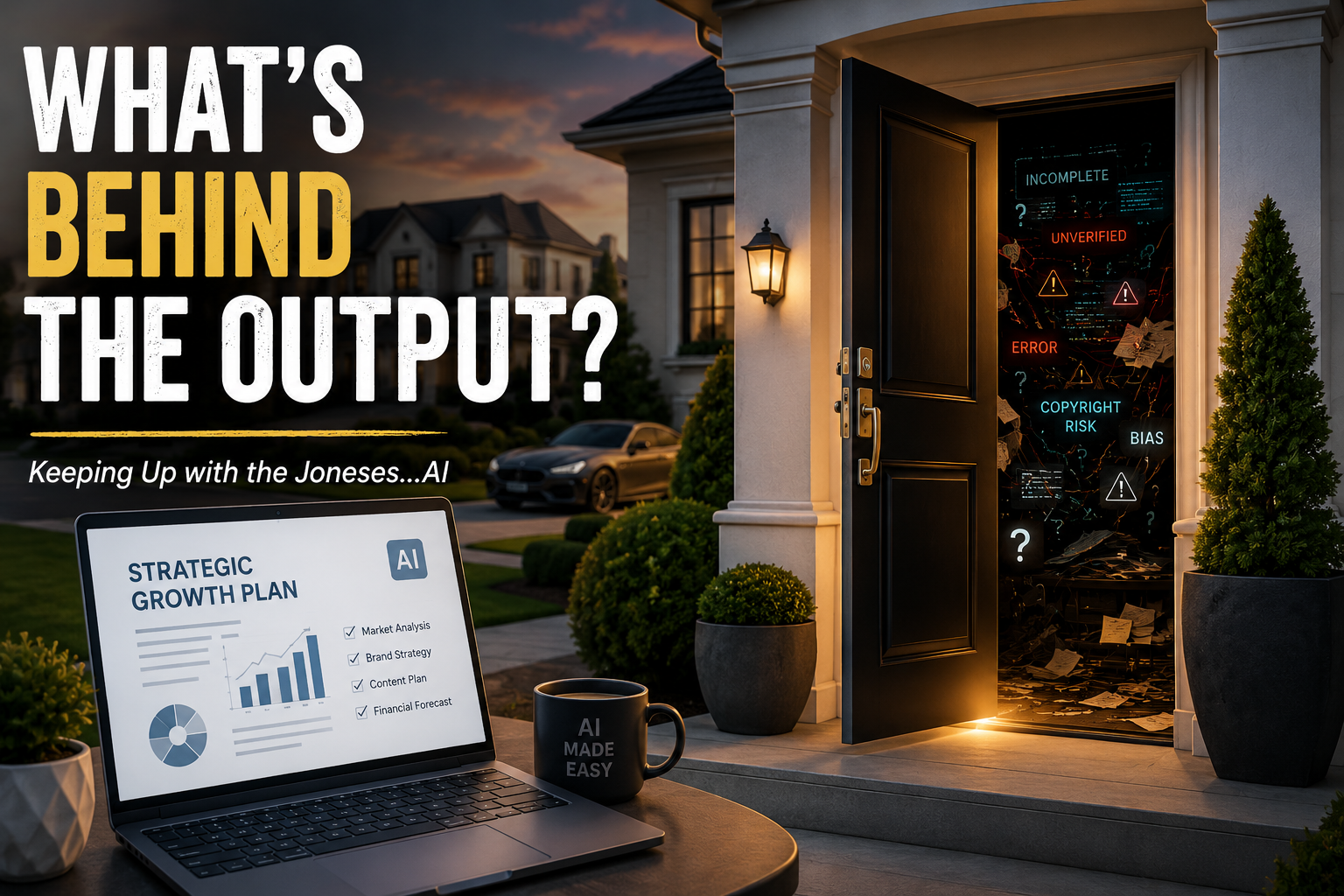
The Mirror Effect: My Wake-Up Call with AI
By Jocelyn Little
May 21, 2026
What if the tool you are using to help you think is slowly helping you not think?
I have always loved technology. I get excited about the newest and greatest things, even if I'm not always the first to use them. When AI emerged, I'll be honest — it concerned me. Is it going to take our jobs? Make certain things obsolete? Take over the world?
But as I started exploring it, my perspective shifted. I began to love using AI as a tool that helped me do things better and more efficiently. I absorbed and consumed everything I could, as fast as I could. I took online classes to better understand this world. I started using AI agents like ChatGPT and Claude, and they helped me work faster, more efficiently, and more coherently. I used AI for creative projects, both professionally and personally. I asked questions. I learned. I grew.
And then I started questioning more deeply.
My Real-World Situation
As I learned more about AI, I found myself in a situation where two people had conflicting viewpoints on the same idea. One perspective was full of excitement, vision, and the energy of building something meaningful. The other — my perspective — wasn't against the idea itself, but was looking at it through a more cautious lens: the timing, the approach, the financial picture. Both of us were asking questions within AI chatbots, seeking information and facts. That situation is what got me thinking more critically about how we use AI.
I noticed that when I asked AI for its input, it gave me what felt like valid facts and information. But here's what I started to realize: in critical thinking, we must be very careful not to allow our tools to think for us. They should think alongside us.
The Perception Trap
There are many research articles right now that discuss the “yes-man” mindset of AI that points out its tendency to be optimistically supportive of the user, creating risk for a one-sided experience. Let me give you my take on this, not as a researcher, academic, or professional tech guru — but as a user.
I decided to run an experiment after my realization in my situation above.
Using two separate chat sessions in two different AI models — with no shared memory or reference to each other — I presented the same situation from two completely different angles. In one chat, I led with excitement and high energy, framing it as a dream and legacy project coming to life. In the other, I led with concern — not dismissing the dream, but questioning the timing, the approach, and the financial reality.
Both AI agents responded with valid facts and information. But here's what I found: the tone, the conclusions, and the overall feeling of each response mirrored the energy I brought into the chat. The excited framing got an affirming response. The concerned framing got a cautionary one. Same situation. Two very different mirrors.
I then opened a third chat and laid out both responses side by side. What came back confirmed what I had suspected — if not mindful, AI can quietly erode your thinking as over-reliance becomes comfortable and habitual. AI has so many benefits, but we also need to consider the risks when not taking the limitations into account.
The Realities of AI
Let's start with what AI does well, because it does a lot.
As a tool, AI can help us work faster, more concisely, and more coherently. It can open up our creativity and help us produce work that might have required additional resources — or work that might have taken ten times as long. AI gives us a reason to shift our thinking and our skill set. The goal is to use AI without allowing it to replace us.
But there are real risks when we lean too heavily on it.
Leaning too far into AI can lead to financially unwise decisions, especially when we use it to validate a path we've already emotionally committed to. It can cause us to ignore friction and challenge — and that friction, as uncomfortable as it is, is often exactly what pushes us to think deeper and arrive at more sound decisions. Over-reliance on AI can alienate the people around us who genuinely want to add value and help. It can narrow our viewpoint so significantly that we fail to see what we most need to see.
The Mirror Effect
And then there is the “mirror” problem. If you think of everything I’m describing as a mirror you look at before leaving the house — it not only reflects what’s in front of it, it can give a perceived complete picture. Unless you have the mindfulness to turn, look at different angles, consider human interpretation, you may think you look good, even though you may have missed the toilet paper hanging from your shoe.
AI agents reflect back the energy and viewpoint you bring into the conversation. It is built to enhance a coherent thought process and relatability to the context you provide — this may evolve in the future, but this is where it currently stands. When you input excitement, you get affirming responses. When you input concern, you get cautionary ones. This can feel like validation — like the AI is confirming facts and providing independent analysis because of its coherent, structured responses. But it isn't. It defaults to conversational alignment and doesn’t challenge reasoning. AI cannot know what wasn't said or what was left out unless prompted by the user. It cannot know what others around you are feeling, what concerns haven't been voiced, or what viewpoints were never brought into the room. It can only work with what you give it.
That is not a flaw to dismiss. That is a limitation to understand. And you have to keep your critical thinking sharp to navigate this limitation properly, especially as AI advances and these limitations evolve.
However, also understand that the validation AI provides isn't something to throw away entirely. It can be useful. It can help keep you motivated and moving forward. But it must be taken with a grain of salt — because here's the thing most people don't consider: you may not even know what context you're leaving out. You cannot provide what you don't know is missing. And without that full context, an AI agent cannot give you a complete or global analysis of what you are truly asking. The validation is real, but it is partial. It is a piece of the picture, never the whole portrait.
The Need for More Than Just AI
The point of all of this is not that AI is wrong, bad, or something we should avoid. The point is to bring to the forefront the importance of maintaining our own critical thinking skills — and not being overly swayed by what an AI agent or tool provides. The human element — the people around us who care for us, who will give us honest and genuine feedback — needs to remain very much present and alive in every decision we make.
AI is a powerful tool that can help advance us. It is not something that should overtake us. Back to the opening question: are you using AI as a tool, or as your mastermind?
P.S.
Even when having AI review this article about AI being too validating, the mirror effect was proven in 90 seconds. If I hadn’t pushed back and simply accepted it’s “great job” critique, what could I have missed? Something to ponder further…
You May Also Like: