From Idea to Impact
At a Glance:
• What it is — An original educational framework, developed to completion as a concept, for teaching teenagers to carry a real idea from concept through execution — sparked by helping my son draft a proposal for a computer science club.
• The recognition that mattered — The proposal itself was the teachable thing schools skip. Not the club, not the topic — the skill of moving an idea into reality.
• Where it came from — Not one spark but several I connected myself: leadership lessons I'd already written for my son, a conversation about which jobs AI is coming for, and a story my aunty told me about a high school whose students were recruited directly by industry.
• How I built it — By thinking out loud with AI as a collaborator, not a content engine. It organized, named patterns, and stress-tested my thinking. It didn't originate the philosophy or the four principles — those trace straight back to convictions I'd written down before AI was ever in the room.
• Where it stands — Concept fully developed, not built or piloted. The honest next step is testing it with my own son on a real idea.
• Skills — original framework design · opportunity recognition · learning experience design · educational philosophy · AI-enabled ideation · systems thinking · self-directed initiative.

Project Spotlight:
Over the course of a single weekend, a loose collection of things I'd been noticing — leadership lessons I'd written for my own teenage son, a conversation about which jobs AI is going to take, a story my aunty told me about a high school whose students were being recruited directly by industry, and a small task of helping my son draft a proposal for a computer science club — converged into one idea. I recognized that the proposal itself was the teachable thing: that we teach kids subjects, but almost never teach them how to move an idea into reality. That recognition became From Idea to Impact, an original framework for teaching teenagers to carry a real idea from concept all the way through execution.
This case study is not about a course I launched, because I haven't launched it yet, and it isn't a business plan, because that isn't what this was. It stops exactly where the real work stopped: at the development of the concept — a framework I believe there is a genuine need for, articulated far enough that its philosophy, its principles, and its design are fully mine and clearly on the page. What makes it worth documenting is how it got there. I built it by thinking out loud with AI as a collaborator — bouncing ideas back and forth until the shape of my own thinking became clear enough to name. The value here isn't that AI helped me write something. It's that I can take a scattered set of sparks, direct a thinking partner through the exploration, and come out the other side with an original framework and a point of view that are unmistakably my own.
Skills demonstrated: opportunity recognition · original framework design · learning experience design · educational philosophy · systems thinking · synthesis across domains · AI-enabled ideation · human-centered problem solving · self-directed initiative.
An original framework, built by thinking out loud with AI — not by asking it for one
I don't outsource my thinking to AI. I use it to hear my own thinking more clearly.
That's the real story behind From Idea to Impact, an educational framework I developed for teaching teenagers to carry a real idea from concept all the way through execution. It started small: helping my teenage son draft a proposal for a computer science club. It didn't stay small for long.
Where it actually came from
Nothing about this arrived as a single idea. It assembled — from things I'd been circling separately for a while.I'd already written down leadership lessons for my son, out of my own experience: that vision without execution goes nowhere, that structure has to adapt instead of staying rigid, that a leader accepts help and feedback and then owns the decision anyway.
Around the same time, I'd been thinking hard about which jobs AI is actually coming for — and which human skills only get more valuable as it does. My aunty told me about a high school whose students were being recruited directly by industry, and it stuck with me: what if school connected straight to real capability?
\
Then came the proposal. And somewhere in the middle of helping my son write it, I saw it: the proposal itself was the thing worth teaching. Not the club, not the topic — the skill of moving an idea into reality, which almost no classroom ever touches.
That's the move the whole framework turns on. Not one lightning-bolt idea, but connecting several things I'd already been carrying — and that connecting is mine.
What I built it with, and what I didn't
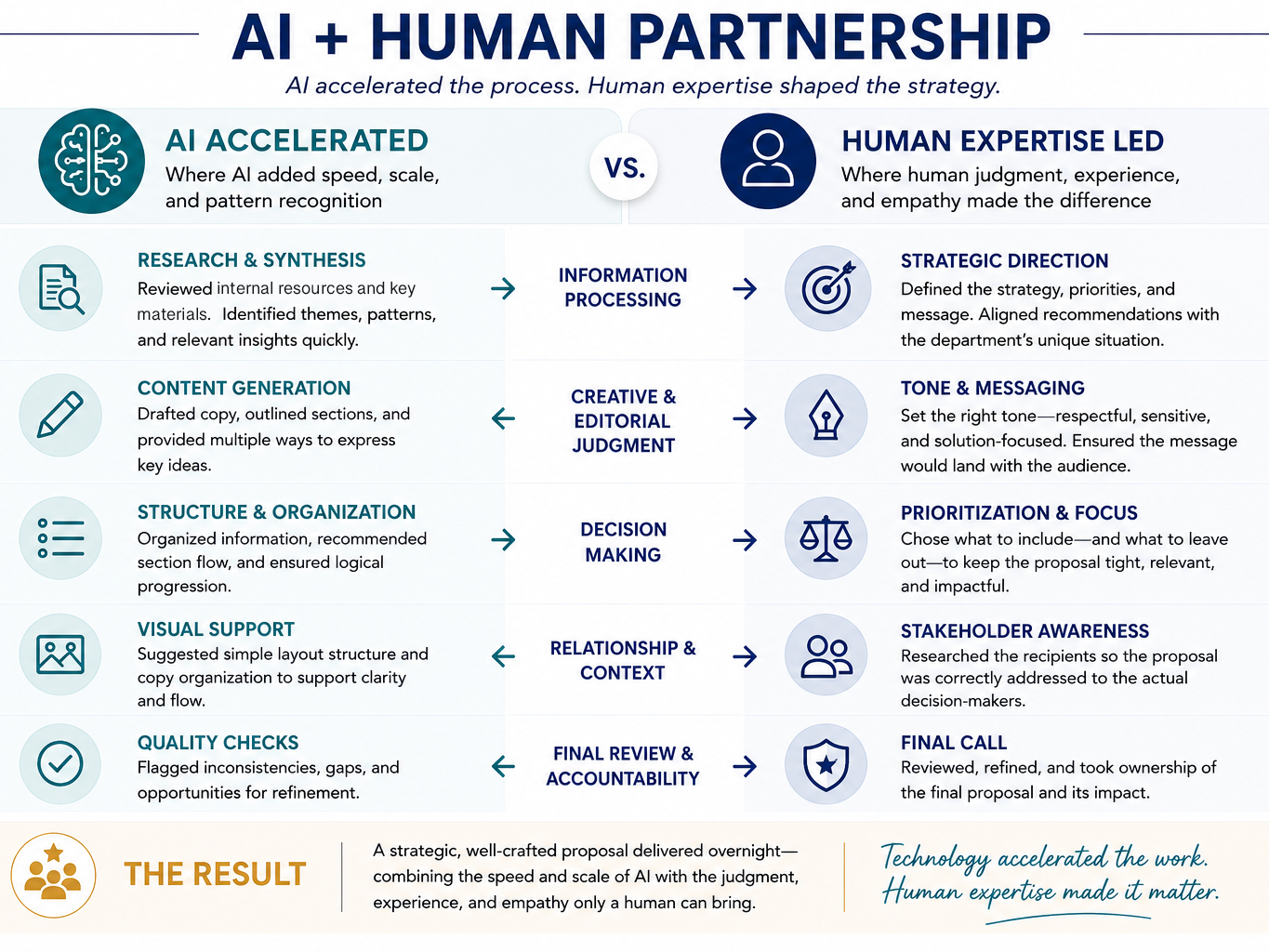
I developed this by talking it through with AI, back and forth, the way you'd think out loud with a sharp collaborator. It organized what I gave it, named patterns I hadn't consciously structured yet, pushed back on ideas that wouldn't hold up under a real teenager hitting a real wall, and helped me get the whole thing documented before it evaporated.What it didn't do: decide what mattered. The four principles underneath this framework — that feedback is information to evaluate, not instruction to obey; that learning success and project success are different things; that persistence has to adapt, not just push harder; that you can delegate responsibility without delegating accountability — those trace straight back to convictions I already had, in my own words, before AI was ever in the room. It helped me see the shape of what I already believed. It didn't hand me the belief.
Where it standsThis is a fully developed concept, not a launched course — and I'm not going to pretend otherwise. The framework, the philosophy, and the signature pieces (a timed planning exercise called the Planathon, and its core debrief question: did the framework survive the pressure, or did it go out the window the moment things got hard?) are built and documented. The next honest step is a real test — running my own son through it on a real idea — and that hasn't happened yet.
The takeaway
The skill on display here isn't "I used AI." It's that I can take a handful of things I've been separately noticing, recognize the pattern connecting them, and direct a thinking partner through turning that pattern into something real — while knowing exactly which parts are mine and which parts the tool helped me see.
Skills: original framework design · opportunity recognition · learning experience design · educational philosophy · AI-enabled ideation · systems thinking · self-directed initiative.

You may also like

Back to Top